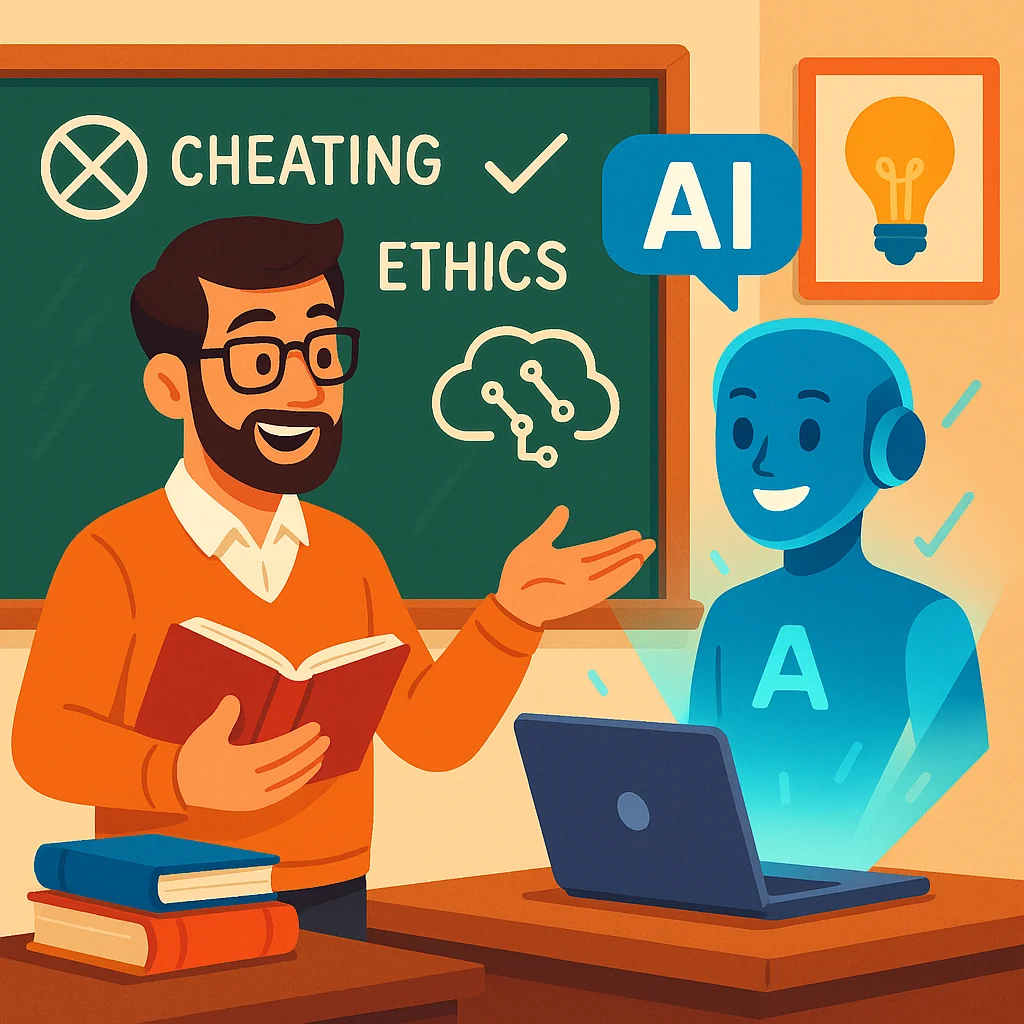
A witty guide to embracing the inevitable while teaching students to dance with artificial intelligence
My fellow educators, gather ’round! We need to talk about the digital elephant in the room, or should I say, the digital assistant in the classroom? That’s right, we’re diving headfirst into the wonderfully chaotic world of AI-related academic dishonesty. But before you reach for your digital torches and pitchforks, let me tell you why this might just be the best thing that’s happened to education since the invention of the whiteboard marker.
The Numbers Game: When 89% of Students Are Already Dancing With AI
Let’s start with some delightfully sobering statistics. Research shows that 89% of students admit to using AI tools like ChatGPT for their homework. Meanwhile, the rate of AI-related academic misconduct has skyrocketed from 1.6 per 1,000 students in 2022-2023 to 7.5 per 1,000 in the most recent academic year. And here’s the kicker, these are just the ones we’ve caught!
As one Stanford researcher aptly put it: “There’s been a ton of media coverage about AI making it easier and more likely for students to cheat, but we haven’t seen that bear out in our data so far. And we know from our research that when students do cheat, it’s typically for reasons that have very little to do with their access to technology”.
In other words, dear colleagues, we’re chasing shadows while the real educational revolution is happening right under our noses.
The Cat-and-Mouse Game: Why Detection Is Missing the Point
Picture this: You’re a linguistic detective, armed with AI detection tools that promise to catch those crafty students red-handed. But here’s the plot twist, current plagiarism detection software only identifies AI-generated text with 67% accuracy. That’s like flipping a coin with slightly better odds!
One professor shared their frustration: “I’ve encountered numerous instances where educators, including myself, receive submissions that prompt the suspicion of AI involvement, yet we lack a straightforward method to substantiate that claim”. Another educator put it beautifully: “I don’t catch them. I’m not a police officer”.
The truth is, clinging to reactive, punitive methods like conventional plagiarism detection feels increasingly like trying to bail water from a sinking ship with a teacup. We’re playing an expensive game of technological whack-a-mole while missing the educational transformation happening all around us.
The Uncomfortable Truth: We’re Fighting the Wrong Battle
Here’s where it gets interesting – and a bit uncomfortable. Research from the University of the Basque Country involving 507 students revealed that the relationship between AI use and plagiarism isn’t as straightforward as we’d like to believe. The study found that other factors contribute more significantly to academic dishonesty than AI use itself, including lack of motivation, hypercompetitive environments, and cultures that normalize cheating.
In essence, we’re treating the symptoms while ignoring the disease. Students aren’t cheating because AI exists; they’re using AI to cheat because of deeper systemic issues in our educational approach.
The Wisdom of Floridi: Ethics in the Age of Artificial Agents
As someone who deeply respects the ethical framework of Luciano Floridi, I find his perspective on AI ethics particularly enlightening. Floridi argues that AI represents an unprecedented divorce between agency and intelligence. In educational terms, this means students can now delegate intellectual tasks to systems that lack true understanding, but this isn’t necessarily a crisis, it’s an opportunity to redefine what we mean by learning and assessment.
Floridi’s unified framework for ethical AI includes five core principles: beneficence, non-maleficence, autonomy, justice, and explicability. Applied to education, this means AI tools should enhance learning (beneficence), avoid harm to intellectual development (non-maleficence), respect student agency (autonomy), ensure equitable access (justice), and operate transparently (explicability).
The Sharma Approach: Leadership Through Transformation
Drawing inspiration from Robin Sharma’s philosophy, we must recognize that “leaders are individuals who do things that failure aren’t willing to do, even though they might not like doing them either”. In our context, this means embracing AI integration rather than fighting it.
As Sharma wisely notes, “All change is hard at first, messy in the middle, and gorgeous at the end”. We’re currently in the messy middle of educational transformation, and our choice is clear: evolve or become irrelevant.
Sharma’s insight that “education is inoculation against disruption” is particularly relevant. Instead of seeing AI as a threat, we should view it as the perfect tool to prepare students for a future where human-AI collaboration will be the norm.
The Real Solution: Teaching AI Literacy, Not AI Avoidance
Here’s where we flip the script entirely. Instead of trying to catch students using AI, we should be teaching them to use it responsibly and effectively. Research on AI literacy frameworks shows that students need to develop four key competencies:
- Understanding AI’s technical dimensions: How does it work, and what are its limitations?
- Learning responsible interaction: When and how to use AI tools appropriately
- Ethical considerations: Understanding bias, privacy, and social implications
- Critical evaluation: Assessing AI outputs and maintaining human oversight
The Practical Path Forward: From Detection to Direction
The most successful educators are already making this shift. They’re using AI tools to enhance lesson planning, provide personalized feedback, and create more engaging learning experiences. Meanwhile, they’re teaching students to:
- Critically evaluate AI outputs for accuracy and bias
- Understand the creative process behind AI-generated content
- Develop prompt engineering skills as a new form of literacy
- Maintain transparency about AI use in their work
The Humor in Our Resistance
Let’s be honest, there’s something deliciously ironic about educators who use spell-check, grammar tools, and Google Search being horrified that students might use ChatGPT. As one educator humorously noted, using AI becomes problematic when it “replaces a student’s original thought, research, and writing without proper acknowledgment”, but isn’t that exactly what we do when we rely on calculators for math or GPS for navigation?
The comedian John Mulaney captured this perfectly when he joked about AI in education creating a world where children “will never talk to an actual human again” and instead get answers from “a little cartoon Einstein”. The joke stings because it highlights our fear of losing human connection in education, but that’s exactly why we need to be involved in shaping how AI is used, not avoiding it entirely.
The Transformation Opportunity
Here’s what being involved in both the education world and business world has taught me: every major technological shift in has been met with resistance, and every successful person has eventually learned to harness that technology for better outcomes.
The evidence is overwhelming! 60% of teachers are already using AI in their classrooms, and institutions that embrace AI integration report improved student engagement, personalized learning experiences, and more efficient administrative processes.
The Call to Action: Embrace the Dance
My friends, the time has come to stop playing detective and start being choreographers. We need to teach students how to dance with AI, not hide from it. This means:
- Developing clear AI usage policies that focus on learning objectives rather than prohibition
- Creating assignments that require human creativity and critical thinking alongside AI assistance
- Teaching students to cite and acknowledge AI use just as they would any other source
- Modeling responsible AI use in our own professional practice
- Fostering discussions about AI ethics and societal implications
The Flourishing Future
As Robin Sharma reminds us, “The treasures of your life will present themselves to you only if you really are open to them”. AI in education is one such treasure; if we’re open to it.
The research is clear: institutions that embrace AI integration thoughtfully and ethically are seeing improved learning outcomes, increased student engagement, and more efficient educational processes. Teachers who learn to use AI tools report feeling more empowered and effective in their roles.
The Choice Is Ours
We stand at a crossroads. We can continue to play the exhausting game of technological whack-a-mole, or we can embrace our role as educational leaders in the AI age. We can teach our students to be thoughtful collaborators with artificial intelligence rather than fearful competitors.
The choice, as Sharma would say, is between being a victim who recites problems or a leader who provides solutions. The problem isn’t that our students are using AI, the problem is that we’re not teaching them to use it well.
So let’s put down our detection tools and pick up our leadership mantles. Let’s stop asking “Are they cheating?” and start asking “Are they learning?” Because in the end, that’s what education has always been about, not the prevention of shortcuts, but the cultivation of wisdom.
The future of education isn’t about humans versus AI; it’s about humans with AI. And that future starts with us choosing to lead rather than lag behind.
Now, who’s ready to start dancing?
The author is using AI tools for article creation ideas, content review, research, and image generation and isn’t the least bit ashamed of it. After all, if we’re going to teach students to use AI responsibly, we’d better model that behavior ourselves.